
Commercial Gutter Cleaning and What Businesses Should Check
TopRatedGutterCleaners.co.uk · 7 October 2026
Commercial gutter cleaning is usually quoted individually on a day rate plus access equipment, because long runs, height and fragile roofs change how the job is done. The Health and Safety Executive says both the client and the contractor have health and safety responsibilities. This means you must check a contractor is competent and working safely before they start.
How commercial gutter cleaning differs
Homeowners usually want a quick fix for a dripping joint or water pouring over the gutter. Commercial buyers need planned maintenance for large retail units, offices, schools or industrial estates. The sheer scale of commercial buildings means the work takes longer and involves entirely different access risks.
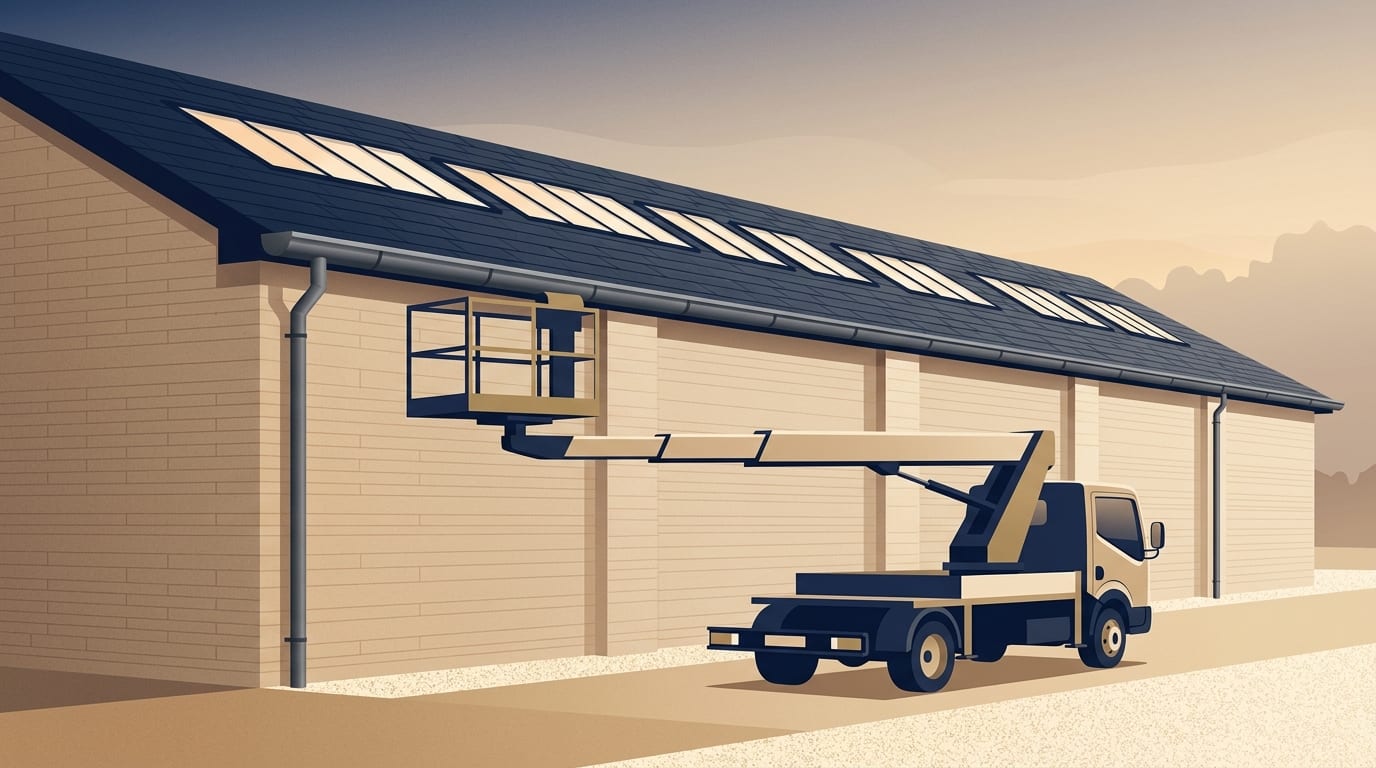
The equipment used is often heavier and more complex. While a domestic property might be cleared with a simple ladder, commercial and industrial gutter cleaning frequently requires a scaffold tower or a mobile elevating work platform to reach high or awkward rooflines.
Scheduling is also different. Schools often need work completed during school holidays to keep children and staff safe. Factories and busy retail parks may require out-of-hours access so that deliveries and production are not disrupted.
Your duties when you bring in a contractor
When you hire a business to clean your commercial gutters, you do not transfer all health and safety risks to them. Under health and safety law, both you and the contractor have responsibilities. You need to identify the job and satisfy yourself that the contractor can do the work safely.
The Health and Safety Executive provides guidance on using contractors safely. You should ask the gutter cleaning company about:
- Their arrangements for managing the work safely
- Whether they will use subcontractors for any part of the job
- Their recent health and safety performance
- The qualifications and experience of the team doing the work
- What training the workers have received
- Their employers' liability insurance certificate
A written health and safety policy and written risk assessments are only required by law if the business employs five or more people. A safety method statement is not required by law, but it is highly recommended because it describes exactly how the job will be carried out safely.
Access equipment and working at height
The Work at Height Regulations 2005 apply to employers and anyone who controls work at height. HSE gives a contractor or a factory owner as examples. The rules state that work must be properly planned, supervised and carried out by competent people with the right equipment.
You must avoid work at height where reasonably practicable. A common way to avoid working at height is by using extendable wet and dry vacuum tools to clear the gutters from ground level. You can learn more about this method in our guide to gutter vacuum cleaning.
Where work at height cannot be avoided, you must prevent falls by using suitable equipment. For commercial buildings, this often means hiring a mobile elevating work platform. If the risk of a fall remains, you must minimise the distance and consequences of that fall.
Ladders and stepladders are not banned in the workplace, and there are many situations where a ladder is the most suitable equipment. However, the Health and Safety Executive guidance on working at height states that ladders suit only low risk, short duration work. HSE guidance for people using ladders at work includes keeping three points of contact, setting the ladder at a 75-degree angle, never resting it against weak surfaces such as plastic gutters, and not working within 6 metres horizontally of an overhead power line.
Fragile roofs and rooflights
Roof work is high risk. Falls from roofs and through fragile roofs and rooflights are among the most common causes of workplace death and serious injury. This danger is present on factories, warehouses and farm buildings during routine repair or cleaning work.
Many large flat-roofed factories and warehouses have internal box gutters. These require the cleaning team to work at height across the roof itself, increasing the risk. You can read more about how these wide systems are cleared in our guide to box, valley and parapet gutters.
All roofs should be treated as fragile until a competent person has confirmed they are not. No sheeted roof should be trusted to bear a person's weight. Falls from flat roof edges can be prevented by installing a secure double guardrail and toeboard.
The Health and Safety Executive lists materials that are likely to be fragile. These include:
- Roof lights and glass, including wired glass
- Liner panels on built-up sheeted roofs
- Non-reinforced fibre cement sheets
- Corroded metal sheets
- Rotted chipboard
- Slates and tiles
Fragile rooflights are a particular hazard during commercial gutter cleaning. Some are hard to see in certain light, and others may be completely hidden by paint.
How commercial jobs are priced
Commercial gutter cleaning prices are usually calculated from a site visit rather than a quick phone call. For larger or commercial buildings, the job is often priced on a day rate for the team, plus the cost of hiring any access equipment.
High level gutter cleaning on large sites with access equipment can run into thousands of pounds per visit. Some contractors price larger or commercial buildings per metre of gutter instead.
A quote is a fixed price for the work described. An estimate is not a fixed price and can increase if the job takes longer than expected. The price of the job will move up or down based on a few clear factors. A massive build up of debris takes longer to clear and pushes the price up. Awkward access that requires a tower or a cherry picker adds significant cost. If your business operates from a converted three-storey property, or has a large glass extension below the gutter line, the job will also cost more because the gutters are harder to reach.
The table below shows how commercial rates compare to domestic work.
|
Type of work |
Typical cost |
|---|---|
|
Commercial day rate (one or two-person team) |
£250 to £500 per day |
|
Commercial per metre rate |
£1.50 to £3 per metre |
|
Cherry picker hire (MEWP) |
£150 to £400 per day |
|
Domestic per metre rate (outside London) |
£4 to £12 per metre |
|
Domestic per metre rate (London and South East) |
£6 to £15 per metre |
These figures are typical published 2026 rates, and the domestic figures include VAT where applicable. Local quotes will differ based on the building size, the amount of debris and how awkward the access is. A cherry picker or scaffold for very high or complex domestic rooflines can add £150 to £500 to the domestic prices shown.
Insurance, paperwork and waste disposal
Commercial buyers usually expect to see a method statement and risk assessment before any work begins on their site. You should also ask for evidence of working at height training for the specific staff who will be operating the equipment.
Public liability insurance pays out if property is damaged or someone is injured during the work. It is not a legal requirement, but commercial clients expect it. Cover of £1 million to £5 million is standard, and many commercial clients demand £5 million of cover. You should ask to see a current certificate.
Employers' liability insurance is compulsory for any business that has employees. If the gutter cleaning company sends staff to your site, they must have this cover in place.
A commercial gutter clean can remove a large amount of wet moss, leaves and silt from the roofline. You need to ask what happens to this debris. Agree in advance whether it will be taken away or left for you to deal with.
If the contractor takes the debris away, they must be registered as a waste carrier. In England, a business that transports waste can get an unlimited fine if it does not register, and you can check a company on the official public register of waste carriers, brokers and dealers. Wales, Scotland and Northern Ireland have their own registration. Ask the contractor for their registration details before you agree to the work.
Contracts and regular maintenance
Commercial clients often want scheduled annual or twice-yearly maintenance under contract.
It is wise to have a written agreement in place for this regular work. The agreement should list every gutter, outlet and downpipe that will be cleaned. It should state the access method and the timing of the work.
You should also agree on how the work will be proven. Ask for before and after photos or camera footage, especially when you cannot see into the gutter from the ground. The agreement should state exactly what happens if a section is missed or a downpipe is left blocked.
A proper job covers every run that was quoted, all the outlets, and a check that the downpipes are flowing freely. You might also want to include common extras in your contract. These can include unblocking downpipes, cleaning fascias and soffits, resealing leaking joints, replacing broken brackets or fitting gutter guards.
Choosing a contractor
You should look out for cold callers who say your commercial gutters or roof need urgent work and quote on the spot. A cheap gutter clean is sometimes used to sell roof repairs you do not need. Always take the time to compare written quotes from established companies. You can check their reputation by reading their Google reviews to see how they have treated other commercial clients.
Be wary of contractors who ask for payment in full up front. You should only pay when the job is finished and you have seen the camera evidence that the gutters are clear.
A poor contractor might only clean the easy runs and leave the awkward sections full of moss. They might also leave the downpipes blocked, which means the gutter will overflow again during the next storm. If you suspect a blockage lower down, read our guide on how to tell if a downpipe is blocked.
Make sure the contractor investigates the actual problem. Water pouring over the edge might be a simple blockage caused by moss and leaves, but it could also be a failed joint, a sagging run of guttering or a blocked drain at ground level. A good contractor will help you tell a cleaning job from a repair job. They will tell you when a clean is enough and when resealing a leaking joint or replacing brackets is required.
Replacing guttering is normally treated as maintenance. However, listed buildings and properties in conservation areas may need consent, so you should check with the local council before agreeing to replacement work.
Common questions
What is industrial gutter cleaning?
Industrial gutter cleaning involves clearing the rainwater systems on large sites like factories, warehouses and distribution centres. It often requires working at height across flat roofs, dealing with internal box gutters and using heavy access equipment to navigate around industrial machinery.
What does high level gutter cleaning involve?
High level gutter cleaning targets buildings that are too tall for standard extendable poles or ladders. It usually involves a mobile elevating work platform to reach the roofline safely, and commercial buyers often ask for evidence of working at height training.
Who is responsible for commercial gutters?
Responsibility for a commercial building depends on what the lease or management agreement says, so check it before you book. For homes let on short tenancies, the law sets out the landlord's duty. In England, section 11 of the Landlord and Tenant Act 1985 makes the landlord of a short tenancy responsible for keeping the structure and exterior in repair, and it specifically names gutters and external pipes.
How do commercial gutter cleaning companies work?
Commercial gutter cleaning companies normally price each site individually, often on a day rate plus access equipment or per metre of gutter. They will visit your site to assess the risks, determine whether a cherry picker or vacuum system is needed, and provide a fixed written quote for the work.
Next steps
Before you hire a commercial gutter cleaner, take these final steps to protect your business:
- Identify exactly which buildings and runs of guttering need clearing
- Ask for a written quote that details the access equipment and the schedule
- Request copies of their public liability insurance and employers' liability insurance
- Ask for a method statement that explains how they will manage the risks of working at height
- Check the public register to ensure they are a registered waste carrier
- Agree that payment will only be made after you have seen before and after photos
- Check the gutters during the next heavy rain to ensure water flows smoothly to the downpipes
Checking a contractor's paperwork is part of satisfying yourself that they can do the job safely. When you are ready to gather quotes and compare local firms, you can find a gutter cleaner near you.
Related Guides
Should You Book Window and Gutter Cleaning Together?
Whether one firm can clean your windows and your gutters, what each job costs in 2026, how often each is needed and what to check before you combine them.

Asbestos Gutters and Downpipes and What to Do About Them
How to tell whether gutters, downpipes or soffits may contain asbestos, whether they can still be cleaned, and what testing, removal and disposal involve.
What to Check Before You Book a Gutter Cleaning Service
The checks worth making before you hire a gutter cleaner, from insurance and waste disposal to photo evidence and a clear written quote.