
Box, Valley and Parapet Gutters and How to Keep Them Clear
TopRatedGutterCleaners.co.uk · 6 October 2026
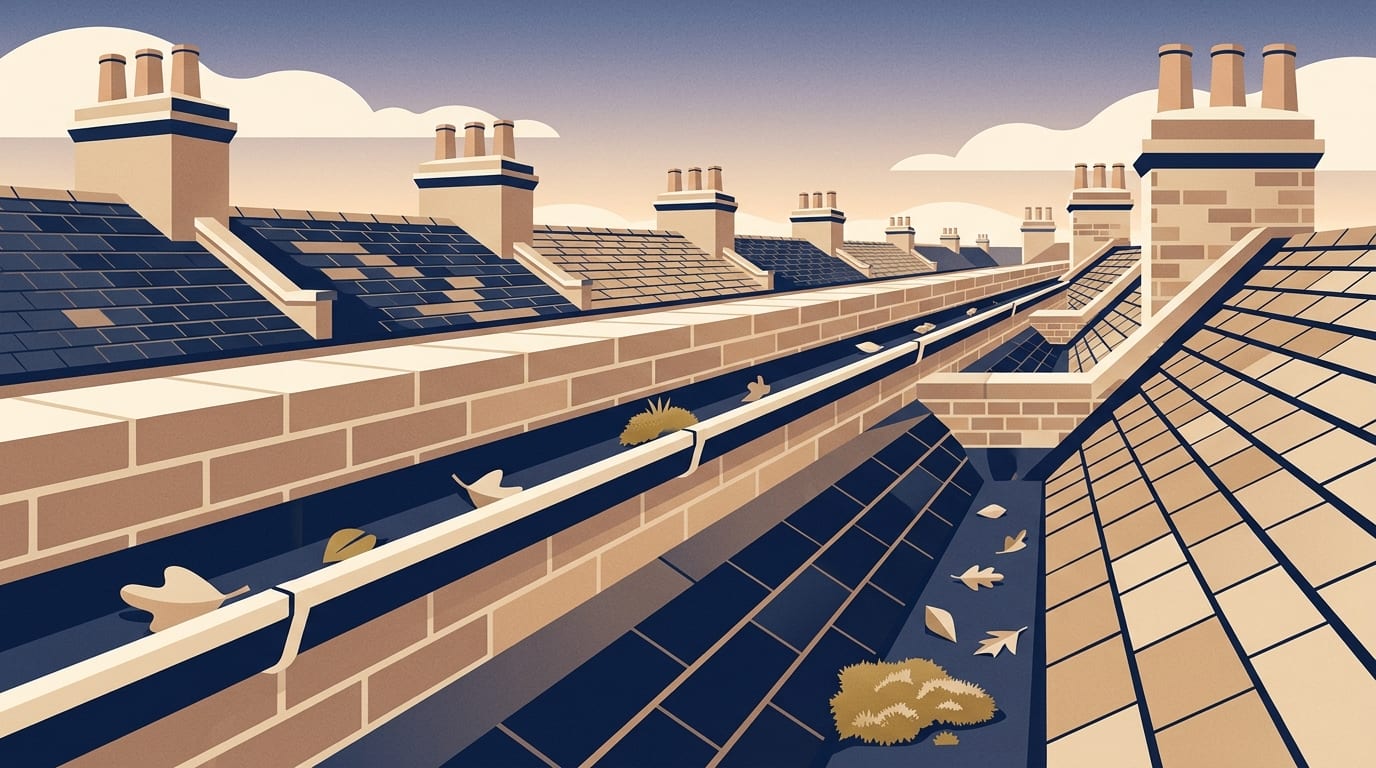
A box gutter is a lined channel hidden within a roof or behind a parapet wall, while a valley gutter runs where two roof slopes meet. Because they sit inside the roofline rather than hanging outside it, blockages can force water directly into your building instead of spilling onto the ground.
What box, valley and parapet gutters are
Standard gutters hang at the eaves of a roof, completely outside the footprint of the house. Hidden gutters are built into the structure of the roof itself, which makes them harder to see and more difficult to access for routine maintenance.
A parapet gutter sits behind a raised brick wall at the edge of the roof, often seen on older terraced houses and period properties. A box gutter is a rectangular channel set between two roof slopes or running alongside a wall, designed to catch water from multiple directions.
A valley gutter forms the internal angle where two pitched roofs meet, carrying rainwater down the crease between the slopes. A secret or hidden valley is a narrower version that is partly covered by the roof tiles, leaving only a small gap for water to enter the channel.
Because these channels are built into the fabric of the building, they are lined with waterproof materials to stop moisture getting into the roof space. They require different access methods and different repair skills compared to standard plastic eaves guttering.
Why hidden gutters cause bigger problems
When an eaves gutter blocks with moss and leaves, the water pours over the edge and falls down the outside of the house. When a hidden gutter blocks, the water pools inside the channel and can find its way into the building.
The official building regulations guidance for England recognises this risk. Approved Document H says that where a design includes valley gutters, parapet gutters or drainage from flat roofs, and over-topping would have particularly high consequences, such as water entering the building, wetting of insulation or other dampness, the design should follow the BS EN 12056 standard.
The same document says gutters should be laid so any overflow caused by above normal rainfall is discharged clear of the building. To reduce the risk of rainwater spilling indoors, additional outlets may be necessary on flat roofs, valley gutters and parapet gutters.
In heavy rain a roof valley carries water from both roof slopes. If it is even slightly blocked with moss, leaves or broken bits of tile, the water can back up and creep under the roof tiles. Our guide on why gutters overflow in heavy rain covers the other common causes.
Signs a hidden gutter is blocked or leaking
Poor rainwater disposal often shows up inside the house before you notice any external problem. Because you cannot see into a box or valley gutter from the ground, the first warning is usually a damp patch on a ceiling.
You should look out for these common signs of a blockage or a failed lining:
- Damp patches and mould appearing on top floor ceilings and walls
- Dark staining on the brickwork directly below a parapet wall
- Plants or grass visible growing high up in the roof valleys
- Water dripping inside the building during heavy rain
These signs are worth acting on quickly. The Society for the Protection of Ancient Buildings (SPAB) notes that investigation of these leaks often finds rot in concealed timbers. Roof truss bearings beneath parapet gutters are one example.
How often they need clearing
Regular maintenance stops debris building up and damming the channels. A local council building maintenance guide lists clearing leaves and debris from gutters and downpipes in March to May and again in September to November.
Booking a professional clear in spring and autumn removes the heavy leaf fall and the spring moss growth. This routine keeps the channels clear before the heaviest seasonal rain arrives.
You should also check your gutters and rainwater goods for leaks during or just after rain. This is a simple way to spot leaks while the system is working.
After high winds and heavy rain, check for overflowing drains at ground level. These can be rodded and cleaned out to keep the whole drainage system moving. You can read more about this schedule in our guide to gutter maintenance through the year.
How hidden gutters are reached safely
Clearing these channels is not a job for a householder. Many hidden gutters can only be reached by getting onto the roof, which requires proper planning, edge protection and professional equipment.
The Health and Safety Executive (HSE) says all roofs should be treated as fragile until a competent person confirms otherwise. The main causes of death and injury in roof work are falls from roof edges or openings, through fragile roofs and through fragile rooflights.
Ladders are not banned, but the HSE guidance states they suit only low risk, short duration work. Properly secured ladders and roof ladders may be used only for work measured in minutes.
HSE guidance for people using ladders at work includes keeping three points of contact and setting the ladder at a 75-degree angle. It also says never to rest a ladder against weak surfaces such as plastic gutters and not to work within 6 metres horizontally of an overhead power line.
Longer roof work needs proper edge protection to prevent falls. Sloping roofs need scaffolding with edge protection at the eaves, while flat roof edges need a secure double guardrail and toeboard. The Work at Height Regulations 2005 require work at height to be properly planned, done by competent people and avoided where reasonably practicable.
Where poor access hinders routine maintenance, the SPAB suggests extra hatches or fixed ladders might be considered to make future clearing safer.
The table below shows typical published prices for gutter clearing in 2026, based on the height and access of the property.
|
Property type |
Outside London |
In London |
|---|---|---|
|
Single-storey or bungalow |
£50 to £90 |
£65 to £110 |
|
Two-storey house |
£80 to £150 |
£100 to £190 |
|
Three-storey or hard access |
£150 to £300 |
£190 to £380 |
These figures are typical published prices for 2026 for ordinary gutter cleaning, and your local quotes will differ based on the exact condition of your gutters. Hidden gutters that need roof access or extra equipment may cost more. If a cherry picker or scaffold is needed for high or complex rooflines, this adds £150 to £500 to the cost. Downpipe unblocking is usually priced as an add-on at £30 to £80, or £40 to £100 in London.
Snow, ice and winter checks
Winter brings a different set of problems for internal gutters. The council maintenance guide advises clearing valley gutters of ice and snow in December to February.
If snow sits in a valley or box gutter, the meltwater may not be able to drain away and can seep through joints in the lining.
The SPAB advises that snow should be cleared from parapet and valley gutters to stop moisture seeping through joints. This clearing must be done carefully to avoid damaging the waterproof lining.
The SPAB recommends using wooden or plastic shovels for this job, because metal tools can damage the lining. Clearing snow from these gutters is roof work, so it is a job for someone with safe access, not for a householder.
Common repairs and what they cost
When debris sits in a gutter for a long time, the trapped moisture can degrade the lining and cause the joints to fail. Leaves, moss and grit damming the channel will eventually force water sideways under the tiles.
A minor repair typically includes re-sealing the joints and clearing out all the debris. A small valley repair usually takes 4 to 6 hours, and a full valley replacement 6 to 8 hours.
When you ask for prices, understand the difference between a quote and an estimate. A quote is a fixed price, while an estimate is a rough guess that can increase. Under the Consumer Rights Act 2015, a service must be carried out with reasonable care and skill, and if it is not you can ask for it to be put right or for your money back.
A service agreed on the doorstep, by phone or online normally carries a 14-day cooling-off period, giving you time to change your mind.
The table below shows typical prices for repairing and replacing valley and parapet gutters, merging costs for both lead and GRP materials.
|
Type of repair work |
Typical price range |
|---|---|
|
Minor valley repair (including re-sealing and clearing) |
£60 to £400 |
|
Full valley replacement or re-lining |
£400 to £1,500 |
|
Parapet gutter relining in lead (installed per metre) |
£100 to £200 |
|
Valley lining in lead (installed per metre) |
£70 to £150 |
|
Valley lining in GRP (installed per metre) |
£55 to £100 |
|
Scaffold to one elevation |
£400 to £900 |
These figures are typical published prices for 2026, and local quotes will differ based on your location and the size of your roof.
Lead and GRP linings
If your hidden gutter needs relining, the two most common materials used by roofers are lead and glass reinforced plastic (GRP). GRP, also known as fibreglass, is cheaper to install based on the typical prices above.
Lead is the traditional material for box and parapet gutters. It is common on older properties, but it requires specialist leadwork skills to install correctly. The SPAB notes that over-sized and over-fixed lead linings may suffer fatigue over time.
Replacing guttering is normally treated as maintenance, but listed buildings and conservation areas may need consent. On listed buildings, replacement should normally be like for like, so an old lead gutter would normally be relined in lead. You should check with your local council before starting any work.
Who to hire for box and valley gutters
It is vital to hire the right trade for the job you need doing. Gutter cleaners clear debris and can show you before and after photos of the cleared channel. Relining a box gutter or replacing a valley is a job for a roofer or a specialist leadworker.
There are two main methods for clearing gutters. A gutter vacuum is a wet and dry vacuum connected to lightweight poles with a curved nozzle. It is worked from the ground, usually with a small camera on the pole so the inside of the gutter can be seen. Manual clearing is done by hand from a ladder, tower or platform, and is still needed for some heavy blockages and for repairs.
A proper job covers every run that was quoted, the outlets, and a check that the downpipes are flowing. Common extras include unblocking downpipes, cleaning fascias and soffits, resealing a leaking joint, replacing brackets, or fitting gutter guards.
You should beware of cold callers who say the gutters or roof need urgent work and quote on the spot. A cheap gutter clean is sometimes used to sell roof repairs you do not need. Other common problems include traders only cleaning the easy runs, leaving downpipes blocked, dumping debris in the garden, and asking for payment in full up front.
A business that transports waste as part of its work must be registered as a waste carrier, and there is a public register you can check. You should always ask the trader what happens to the debris they remove.
You should also ask for a current insurance certificate. Employers' liability insurance is compulsory for a business with employees. Public liability insurance is not a legal requirement, but it is the cover that pays if your property is damaged or someone is injured.
If you rent your home in England, section 11 of the Landlord and Tenant Act 1985 makes the landlord of a short tenancy responsible for keeping the structure and exterior in repair. This law specifically names gutters and external pipes as the landlord's responsibility.
Common questions
What are secret gutters?
Secret gutters, also known as hidden valleys, are narrow channels built where two roof slopes meet. They are partly covered by the roof tiles, which makes them hard to see from the ground and difficult to clear of moss and leaves without getting onto the roof.
Can a leaking box gutter be repaired?
Yes, a leaking box gutter can often be repaired if the damage is minor and isolated to a single joint. If the lead lining has suffered widespread fatigue, relining is more likely to be needed.
How do you clean a valley gutter?
Valley gutters are cleaned by removing the debris by hand or using a gutter vacuum system with lightweight poles. Because they sit within the roof, safe access often needs scaffolding with edge protection or a cherry picker.
How do I know if the problem is a blockage or a repair?
A blockage will cause water to back up and overflow during heavy rain, but the gutter should drain normally once cleared. If you pay for a clean when the real fault is a failed joint, a sagging run or a blocked drain, the leak will carry on after the clean.
Next steps before you hire
Before you hire a professional to clear or repair your hidden gutters, follow this checklist to protect your property and your money:
- Look for damp patches on top floor ceilings or staining below parapet walls
- Decide if you need a routine clean or a structural repair, and contact the right trade
- Ask for a fixed price quote that lists exactly which runs and outlets will be cleared
- Ask to see a current public liability insurance certificate before work begins
- Check the trader is registered as a waste carrier and ask how the debris will be removed
- Expect the trader to provide before and after photos of the hidden gutters once the job is done
- Check the gutters during the next heavy rain to ensure water is flowing freely to the downpipes
Hidden gutters protect the most vulnerable parts of your roof, so keeping them clear of moss and leaves is one of the simplest ways to prevent damp inside your home. If you have noticed water backing up or damp patches on your ceilings, it is time to find a gutter cleaner near you to inspect the channels and clear the blockages.
Related Guides
Half Round, Square, Ogee and Deep Flow Gutter Profiles Compared
How half round, square, ogee and deep flow gutters differ in looks and capacity, what each costs per metre in 2026 and how to choose one when you replace.

Eaves Trays Explained and What Fitting Them Costs
What eaves trays are, how rotten felt at the roof edge lets rain run behind your gutters, what fitting trays costs in 2026 and how to check it is done right.

What Is a Soakaway and What to Do When It Stops Draining
What a soakaway is, how to tell if your downpipes drain to one, the signs it is failing, what clearing or replacing it costs and the rebate you may be owed.