
Half Round, Square, Ogee and Deep Flow Gutter Profiles Compared
TopRatedGutterCleaners.co.uk · 7 October 2026
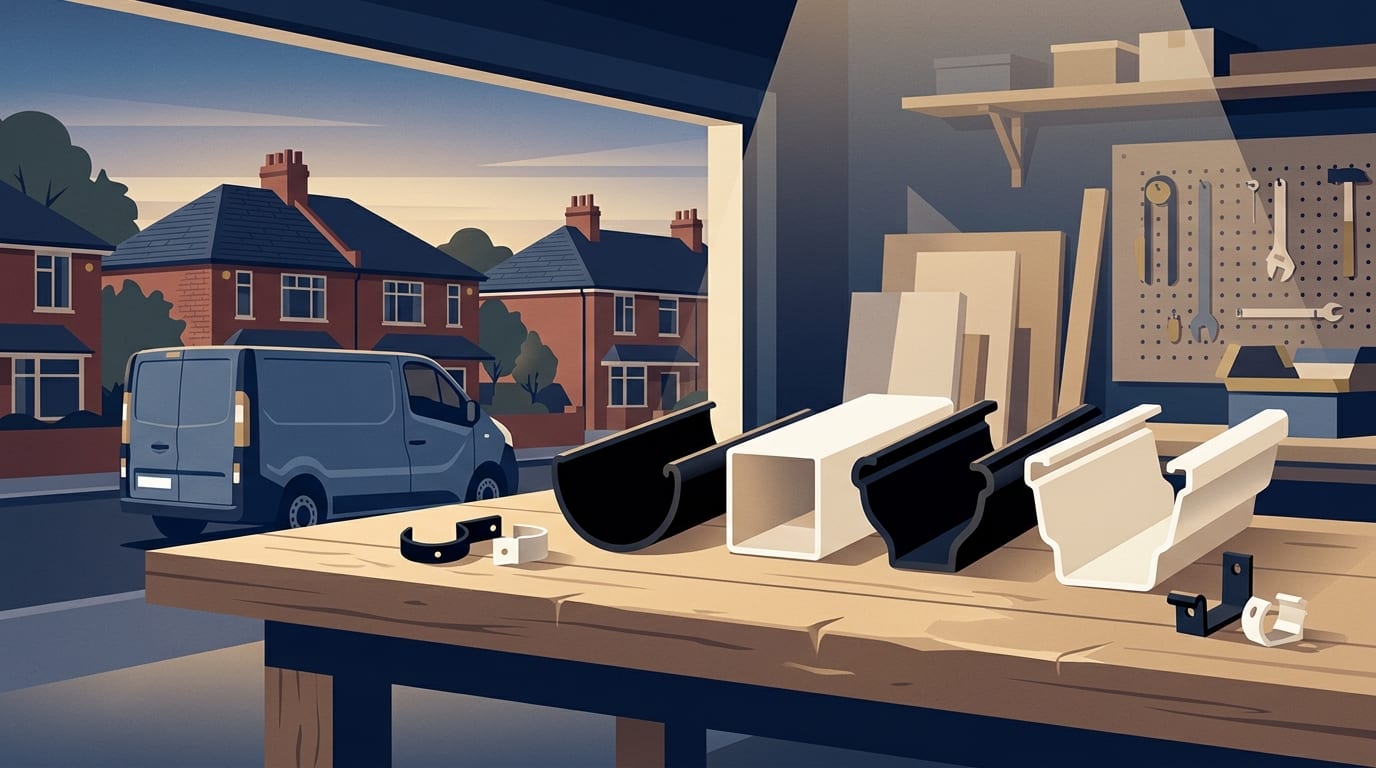
Half round is the traditional rounded shape, square is a flat-bottomed rectangular shape, ogee has a flat back and a decorative shaped front, and deep flow is a deeper section for bigger or steeper roofs. Square, ogee and deep flow carry more water than standard half round. Picking the right profile helps you match a neighbour on a shared run or stop rainwater pouring over the rim during a storm.
What a gutter profile is and why it matters
The profile is the shape of the gutter when you look at it from the end. This shape decides how much water the channel can hold and how fast it flows towards the downpipe. It also changes how the roofline looks from the ground.
Replacing your guttering usually falls under permitted development and counts as maintenance. This means fitting a new profile does not normally need planning permission or Building Regulations approval. Listed buildings and homes in conservation areas are the exception, as explained below.
Half round gutters
Half round is the traditional rounded profile that most people picture when they think of guttering. It provides a simple curved channel that allows water to flow easily without pooling in corners.
This shape is common on older properties across the UK. It is a good match for cast iron systems and heritage looks, blending in with classic architecture. It offers moderate capacity.
Square gutters
Square gutters have a clean, modern rectangular profile with a flat bottom. They are sometimes called squareline gutters by installers and suppliers.
This straight edged shape is popular on newer builds and sits neatly against flat plastic fascias. A square profile provides slightly higher capacity than an equivalent half round gutter. The flat bottom allows more water to sit in the channel before it reaches the rim.
Ogee gutters
Ogee is a decorative profile with a flat back and a shaped front. The front edge features curves and ridges that give it a classic appearance, mimicking traditional Victorian designs.
The flat back sits neatly against the fascia board, which makes it easy to fix securely to the property. It is the most popular uPVC choice on modern homes. It provides good capacity that is higher than the standard half round shape.
Deep flow and high capacity gutters
Deep flow is a deeper section designed for large roof areas, steep pitches and high rainfall regions. It is also known as high capacity guttering. This profile holds more water than standard half round and reduces the risk of water pouring over the edge during heavy storms.
Installers advise upgrading to a deep flow profile in several specific situations:
- When a single gutter run drains a large roof slope
- Where the roof has a steep pitch that sends water down quickly
- When the property is located in a high rainfall area
- Where you have reported an overflow problem with the existing setup
Undersizing the gutter channel is a common reason installers are called back to a job. If your clean gutters still let water cascade over the side, you can read more about why gutters overflow to understand the problem.
How much roof each profile can drain
The shape of the gutter determines how much rainwater it can handle before it spills over. The table below shows the rough roof area a single downpipe can serve for each common profile.
|
Profile |
Rough roof area served by a single downpipe |
|---|---|
|
Half round |
43 square metres |
|
Square |
70 square metres |
|
Deep flow |
90 square metres |
|
Ogee |
103 square metres |
These are typical published figures for 2026. The real capacity depends on your roof pitch, how many outlets there are, where the outlets are placed, and whether the gutter has a fall.
The official building guidance for England in Approved Document H explains that the flow into a gutter depends on the area being drained, whether the roof is flat or pitched, and the angle of pitch. A pitched roof is treated as a larger effective area than its flat plan area. The sizing table in the document refers to half round gutters laid level with a sharp edged outlet at one end.
Where there is a fall, or the gutter has a section which gives it larger capacity than a half round gutter, or the outlet is round edged, it may be possible to reduce the size of the gutter and pipe. Gutters should always be laid with any fall towards the nearest outlet.
What each profile costs per metre
The material you choose changes the price far more than the profile shape does. The table below compares the supply only prices per metre for the three main materials.
|
Material |
Half round |
Square |
Ogee |
|---|---|---|---|
|
uPVC |
£2 to £5 |
£3 to £6 |
£3 to £8 |
|
Aluminium |
£22 to £28 |
£24 to £30 |
£28 to £37 |
|
Cast iron |
£18 to £25 |
£23 to £28 |
£26 to £35 |
These are typical published prices for 2026 for materials only, and local quotes will differ. The cost of supply and fit for standard uPVC gutter replacement is usually around £40 to £50 per metre. Labour and access make up most of the bill.
Gutter cleaning is priced differently, usually per job. The price depends on the type and height of the property, the length of guttering, how much debris has built up, and how awkward the access is. Conservatories and extensions below the gutter line add to the cost. Three-storey houses cost more. Awkward jobs may need a tower or access platform, which pushes the price up.
Matching neighbours and period homes
If you live in a terraced or semi-detached home, your gutter run often continues onto the neighbour's house. You may need to match a neighbouring property's existing system. This can limit your choice of material and affect the final cost.
On terraced houses, often only the front and rear runs are accessible and owned by you. The party sections are shared, and shared sections need agreement before work begins. If you are fitting plastic gutters, uPVC is available in black, white, brown, grey and anthracite to help you match the existing roofline.
Listed buildings and homes in conservation areas have stricter rules. Replacing guttering is normally treated as maintenance, but in these areas consent may be required. Check with the council before you start. Listed building consent is needed for works to alter or extend a listed building in a way likely to affect its character. It is a criminal offence to carry out work that needs listed building consent without getting it first. There is no fee for a listed building consent application.
The Society for the Protection of Ancient Buildings provides guidance on rainwater fittings for period homes. Repair of old rainwater fittings is preferable to replacement where feasible. Replacement, where unavoidable, should normally be like for like. Inappropriate substitute materials, for example PVCu instead of cast iron, can erode a building's character or lead to premature failure as with certain combinations of dissimilar metals. Painted cast aluminium might be acceptable in place of cast iron where access for repainting is exceptionally awkward.
Keeping your new gutters clear
Once you choose a profile, it needs to be kept clear of leaves and moss. There are two main methods for gutter cleaning. A gutter vacuum is a wet and dry vacuum connected to lightweight poles with a curved nozzle. It is worked from the ground, usually with a small camera on the pole so the inside of the gutter can be seen. Manual clearing is done by hand from a ladder, tower or platform. It is still needed for some heavy blockages and for repairs.
Ladders are not banned, but the Health and Safety Executive says they suit only low risk, short duration work. Its guidance for people using ladders at work includes keeping three points of contact and setting the ladder at a 75-degree angle. It also says never to rest a ladder against weak surfaces such as plastic gutters, and not to work within 6 metres horizontally of an overhead power line. The Work at Height Regulations 2005 require work at height to be properly planned, done by competent people and avoided where reasonably practicable.
A business that transports waste as part of its work must be registered as a waste carrier, and there is a public register. You should ask what happens to the debris removed from your gutters.
Employers' liability insurance is compulsory for a business with employees. Public liability insurance is not a legal requirement, but it is the cover that pays if property is damaged or someone is injured. You should ask to see a current certificate before work starts.
How to tell a cleaning job from a repair job
Before you decide to replace your gutter profile, you need to know if the current system is just blocked or actually broken. Paying for a clean when the real fault is a failed joint, a sagging run or a blocked drain is a waste of money.
A blockage usually causes water to fill the channel and pour over the rim during heavy rain. You might see plants growing in the gutter or water overflowing near the top of the downpipe because the debris has stopped the flow. This is a cleaning job. The amount of debris that has built up will affect the final price of the clear out.
A repair job is needed when the physical parts fail. If you see a steady drip from a specific connection, the likely fault is a failed joint that needs resealing. If the gutter run sags in the middle, water can pool in the dip and pour over the side, even if the channel is clear. Sagging runs need a tradesperson to adjust or replace the brackets. Repairs like these are done by hand from a ladder, tower or platform rather than from the ground.
Rights and responsibilities for gutter repairs
If you rent your home in England, section 11 of the Landlord and Tenant Act 1985 makes the landlord of a short tenancy responsible for keeping the structure and exterior in repair. The Act specifically names gutters and external pipes.
When you hire someone to repair or replace your gutters, a quote is a fixed price. An estimate is not. A quote is a promise to do work at an agreed price, and the trader cannot charge more without a good reason. Good reasons include extra work they told you about and you agreed to pay for, or an obvious mistake in the quote. An estimate is just the trader's best guess.
Under the Consumer Rights Act 2015, a service must be carried out with reasonable care and skill. If it is not, the customer can ask for it to be put right or for money back. A service agreed on the doorstep, by phone or online normally carries a 14-day cooling-off period.
There are common problems to warn about when dealing with bad traders:
- Cold callers who say the gutters or roof need urgent work and quote on the spot
- A cheap gutter clean used to sell roof repairs you do not need
- Only the easy runs cleaned while awkward sections are ignored
- Downpipes left blocked after the main channel is cleared
- Debris dumped in the garden instead of being taken away
- Paying in full up front before the job is finished
A proper job covers every run that was quoted, the outlets, and a check that the downpipes are flowing. Common extras you might agree to include unblocking downpipes, cleaning fascias and soffits, resealing a leaking joint, replacing brackets, and fitting gutter guards.
Common questions
What are the different types of guttering?
The four main profiles are half round, square, ogee and deep flow. Half round is the traditional curved shape, square has a flat bottom, and ogee has a decorative shaped front. Deep flow is a taller version designed to hold a larger volume of rainwater.
How do I know what gutter sizes I need in the UK?
The size you need depends on the roof area, the pitch of the roof, the number of outlets, and where those outlets are positioned. A large or steep roof catches more driving rain and sends it into the channel faster. If a standard size cannot handle the flow, you will need a deeper or higher capacity section to stop the water spilling over.
Are square or round gutters better?
Squareline gutters offer slightly higher capacity than an equivalent half round profile, which helps them handle heavier downpours. They are popular on modern builds with flat fascias. Half round gutters are the traditional choice and provide a better match for older properties and heritage looks.
What is high capacity guttering?
High capacity guttering, often called deep flow, is a deeper channel designed to hold and move more water than standard half round. It is used for large roof areas, steep pitches, and homes in high rainfall regions. Installers often fit it when standard gutters repeatedly overflow during heavy storms.
Choosing a profile when you replace your gutters
Before you book an installer, take time to decide whether you need a repair or replacement. If replacement is the only option, you need to make sure the new profile solves your drainage problems and matches your home.
A reliable written quote should list:
- The profile shape and material being installed
- The colour of the uPVC or metal
- The number of outlets and downpipes included
- How the old gutters will be removed and disposed of
- Whether access equipment like a tower is included in the price
If your old gutters overflowed when they were clean, ask the installer to check the roof area and outlets before they order the parts. Match the existing system where it is shared with a neighbour, and ask for before and after photos so you can see the finished work without climbing a ladder.
What to check in the next heavy rain:
- Water flows smoothly towards the downpipes without pooling in the middle of the run
- No water drips or streams from the joints connecting the gutter lengths
- Rainwater does not shoot over the front edge of the new profile
- The downpipes are flowing freely at the bottom without water backing up to the roof
Finding the right tradesperson means asking the right questions and checking their paperwork. When you are ready to get quotes for your new profile, you can find a gutter cleaner near you to inspect your roofline and recommend the best option.
Related Guides

Eaves Trays Explained and What Fitting Them Costs
What eaves trays are, how rotten felt at the roof edge lets rain run behind your gutters, what fitting trays costs in 2026 and how to check it is done right.

What Is a Soakaway and What to Do When It Stops Draining
What a soakaway is, how to tell if your downpipes drain to one, the signs it is failing, what clearing or replacing it costs and the rebate you may be owed.

Flat Roof Drainage and Why Water Pools After Rain
How a flat roof sheds rain through edge gutters and outlets, why water pools on it, what clearing and outlet work costs and when ponding means a roofer.