
Gutter Vacuum Cleaning and How It Works
TopRatedGutterCleaners.co.uk · 30 September 2026

A gutter vacuum is a powerful wet and dry vacuum connected to lightweight poles that allows a professional to clear your gutters from the ground. It uses a curved nozzle to reach into the guttering and usually has a small camera attached so the operator can see the debris inside. If you are hiring a firm to clear your gutters in the UK, this is the method they are most likely to use.
What is a gutter vacuum?
Professional gutter cleaning usually relies on high-reach vacuum systems rather than ladders and buckets. The core of the system is a heavy-duty wet and dry vacuum designed to handle standing water, rotting leaves, moss and silt. This unit stays on the ground and is connected to a series of lightweight poles that reach up to the roofline.
At the top of the poles sits a curved nozzle that hooks over the edge of the gutter. A small camera is usually mounted near the nozzle, sending a live video feed to a monitor on the ground. This allows the operator to see exactly what they are doing and ensure no debris is left behind.
You can buy domestic attachments for standard household vacuums, but they are not the same as professional equipment. A commercial gutter vacuum has far more suction and is built to lift heavy, wet debris from upper-storey gutters.
How gutter vacuum cleaning works step by step
Knowing what a proper job looks like helps you spot contractors who cut corners. A reliable firm will follow a careful process to ensure your gutters are completely clear and flowing freely.
- The operator walks around your property to check access and look for obvious faults like a dripping joint or a damp patch on a wall
- A camera is raised on the pole to inspect the gutters, showing how much debris has built up and whether there are established plants or just loose leaves
- The vacuum is turned on and the operator works along each run from the ground, lifting out moss, leaves, silt and standing water
- The outlets are cleared and the top sections of the downpipes are checked to ensure rainwater can flow away
- A final camera survey is done to capture after photos, proving that every run quoted for is completely clear
The time spent on site ranges from 30 minutes to a couple of hours for a typical house. If the access is very awkward or the gutters have a heavy build-up of debris, the job can take several hours to complete.
Why cleaning from the ground is safer
Using a vacuum from the ground removes the need for ladders on most routine jobs. The Work at Height Regulations 2005 require work at height to be properly planned and done by competent people. The law expects work at height to be avoided where it is reasonably practicable to do so, before access equipment such as ladders is considered.
Ladders are not banned, but the Health and Safety Executive says they suit only low-risk, short-duration work. Its guidance for people using ladders at work includes keeping three points of contact and setting the ladder at a 75-degree angle. It also says not to rest a leaning ladder against weak upper surfaces such as plastic gutters, which can crack or give way under the weight.
Working from the ground does not remove every risk, and long poles must be kept well away from overhead power lines. HSE guidance warns that going close to a live overhead line can cause a flashover that may kill, without the line even being touched. HSE's ladder guidance says not to work within 6 metres horizontally of an overhead power line unless it has been made dead or is protected with insulation. Long poles call for the same caution, so point out any overhead cables before the equipment is raised.
What a gutter vacuum can and cannot clear
A vacuum is highly effective for routine maintenance. It easily removes loose leaves, twigs, chunks of moss, standing water and the thick silt that washes off roof tiles. Because the suction is powerful, it can pull this debris from awkward corners and narrow gaps without damaging the plastic.
However, a vacuum has limits. It cannot pull out established plants that have grown deep root systems into the joints of the guttering. It will also struggle with compacted silt that has dried out and turned solid over many years. In these cases, the operator will need to use safe access equipment to loosen the blockage by hand.
A vacuum also cannot fix structural problems. If your gutter is sagging, missing brackets, or leaking from a broken seal, cleaning it will not stop the water escaping. Our guide to gutter repair or replacement explains when a repair is enough, and any repair such as replacing a joint needs hands-on access and not a vacuum.
Reaching over conservatories and extensions
One of the main benefits of a pole system is its reach. If you have a conservatory, a single-storey extension or a porch directly below your main roof, a ladder often cannot get close enough to the upper gutters. Leaning a ladder on a fragile conservatory roof is highly dangerous and damages the structure.
A vacuum operator can stand on the ground and angle the lightweight poles over the top of the extension to reach the main gutters. This clears the blockage without anyone needing to step onto fragile roofing materials or hire expensive access platforms.
This method is also used for three-storey houses. Reaching the gutters of a three-storey property with a ladder is difficult and increases the safety risks significantly. A vacuum system lets the operator stay on the ground, although three-storey homes cost more to clean.
Camera footage and proof of the work
Because you cannot see into your gutters from the ground, it is hard to know if a contractor has actually done the work. A camera mounted on the vacuum pole solves this problem. The operator can record exactly what the gutters look like before they start and after they finish.
A good firm will gladly show you this footage or send you the before and after photos. This proves that every run covered in the quote has been cleared, rather than just the easy sections near the road.
If a contractor arrives without a camera, ask how they will show you the result. Our guide on what to check before you book covers the evidence to ask for before you hand over any money.
How much gutter vacuum cleaning costs
Gutter vacuum cleaning is usually priced per job, just like any other method. The cost depends on the type and height of your property, the length of the guttering, how much debris has built up and how awkward the access is. Conservatories and extensions below the gutter line will push the price up.
Outside London and the South East, a bungalow usually costs £50 to £90 to clear. A standard two-storey home ranges from £80 to £150. If you live in a three-storey house or have very awkward access, expect to pay £150 to £300. Where access is so difficult that scaffolding is needed instead, the cost of the whole job rises to about £375 to £425.
The table below shows typical published prices for a gutter vacuum clean outside London and the South East based on the type of house.
|
House type |
Typical price range |
|---|---|
|
Terraced |
£60 to £90 |
|
Semi-detached |
£80 to £120 |
|
Detached |
£120 to £180 |
These figures represent typical published prices for 2026, and local quotes will differ depending on your property.
If you live in London or the South East, prices are generally higher for the same work.
|
House type |
Typical price range |
|---|---|
|
Terraced |
£75 to £120 |
|
Semi-detached |
£100 to £150 |
|
Detached |
£150 to £230 |
These are also typical published prices for 2026, but the final cost relies on exactly how much debris has built up and how easy the gutters are to reach.
Gutter vacuum or ladder and hand clearing
Manual clearing is done by hand from a ladder, scaffold tower or mobile access platform. While a vacuum is the primary tool for most firms today, manual clearing is still required for specific tasks. A reputable firm will explain which method suits your property best.
If you have debris lodged deep inside a downpipe, a vacuum can only reach so far. The operator may need to use a ladder to safely dismantle the pipe by hand, clear the blockage, and put it back together. Hands-on access is also the only way to reseal a leaking joint, replace broken brackets or fit gutter guards.
You should not expect to pay more simply because a firm uses a vacuum and not a ladder. The price is based on the condition of the gutters and the height of the property, not on the equipment the contractor prefers to use.
Rules and protections to know
When hiring someone to work on your property, there are legal rules and protections you should understand. Under the Consumer Rights Act 2015, a service must be carried out with reasonable care and skill. If it is not, you can ask the firm to put it right or ask for your money back.
Always ask for a quote rather than an estimate. A quote is a fixed price for the work agreed, whereas an estimate is not and can increase on the day. If you agree to a service on the doorstep, by phone or online, the agreement normally carries a 14-day cooling-off period.
A business that transports waste as part of its work must be registered as a waste carrier. There is a public register you can check, and you should always ask what happens to the debris pulled from your gutters. Employers' liability insurance is compulsory for a business with employees. Public liability insurance is not a legal requirement, but it is the cover that pays if your property is damaged or someone is injured, so ask to see a current certificate.
If you rent your home in England, section 11 of the Landlord and Tenant Act 1985 makes the landlord of a short tenancy responsible for keeping the structure and exterior in repair, and it specifically names gutters and external pipes. Replacing guttering is normally treated as maintenance, but listed buildings and conservation areas may need consent, so check with your local council before agreeing to replacement work.
Common problems to avoid
The gutter cleaning trade attracts its share of rogue operators. Knowing the warning signs helps you avoid poor workmanship and unnecessary costs. Look out for:
- Cold callers who say your gutters or roof need urgent work and quote on the spot
- A cheap gutter clean used simply to sell roof repairs you do not need
- Contractors who provide no before and after photos of the cleared runs
- Firms that only clear the easy runs and leave the awkward sections full of debris
- Downpipes left blocked because the operator did not check the flow of water
- Debris dumped in your garden instead of being taken away properly
- Demands for you to pay in full up front before any work begins
- Paying for a clean when the real fault is a failed joint, a sagging run or a blocked drain
Common questions
What is gutter vacuuming?
It is a professional method of clearing debris from gutters using a powerful wet and dry vacuum. The vacuum is connected to long poles, allowing the operator to clear leaves, moss and silt safely from the ground.
Can you clean gutters from the ground?
Yes, professional contractors routinely clean gutters from the ground using vacuum equipment and pole systems. This removes the need for ladders on most standard residential jobs and easily reaches over lower extensions.
Is a gutter vac better than clearing by hand?
A vacuum is generally safer and faster for routine clearing of loose leaves, moss and standing water. However, clearing by hand is still required for heavy blockages, established plants with deep roots, and any structural repair work.
Do gutter cleaning vacuums unblock downpipes?
A vacuum can clear the top opening of a downpipe where leaves often gather and block the flow of rainwater. If a blockage is lodged deep inside the pipe, the operator may need to dismantle the pipe by hand to clear it completely.
What to do before the cleaner arrives
A little preparation ensures the job goes smoothly and helps the operator work safely around your home. Follow this short checklist before the contractor arrives:
- Move your cars off the driveway so the operator has clear space to walk with long poles
- Unlock any side gates so the cleaner can reach the back of your property without delay
- Clear away garden furniture or children's toys that sit directly below the gutter line
- Point out any overhead cables, especially power lines, before any equipment is unloaded
- Check your paperwork to confirm exactly what was included in your fixed-price quote
Once you know what the job involves and what evidence to ask for, you can find a gutter cleaner near you who will carry out the work safely and professionally.
Related Guides
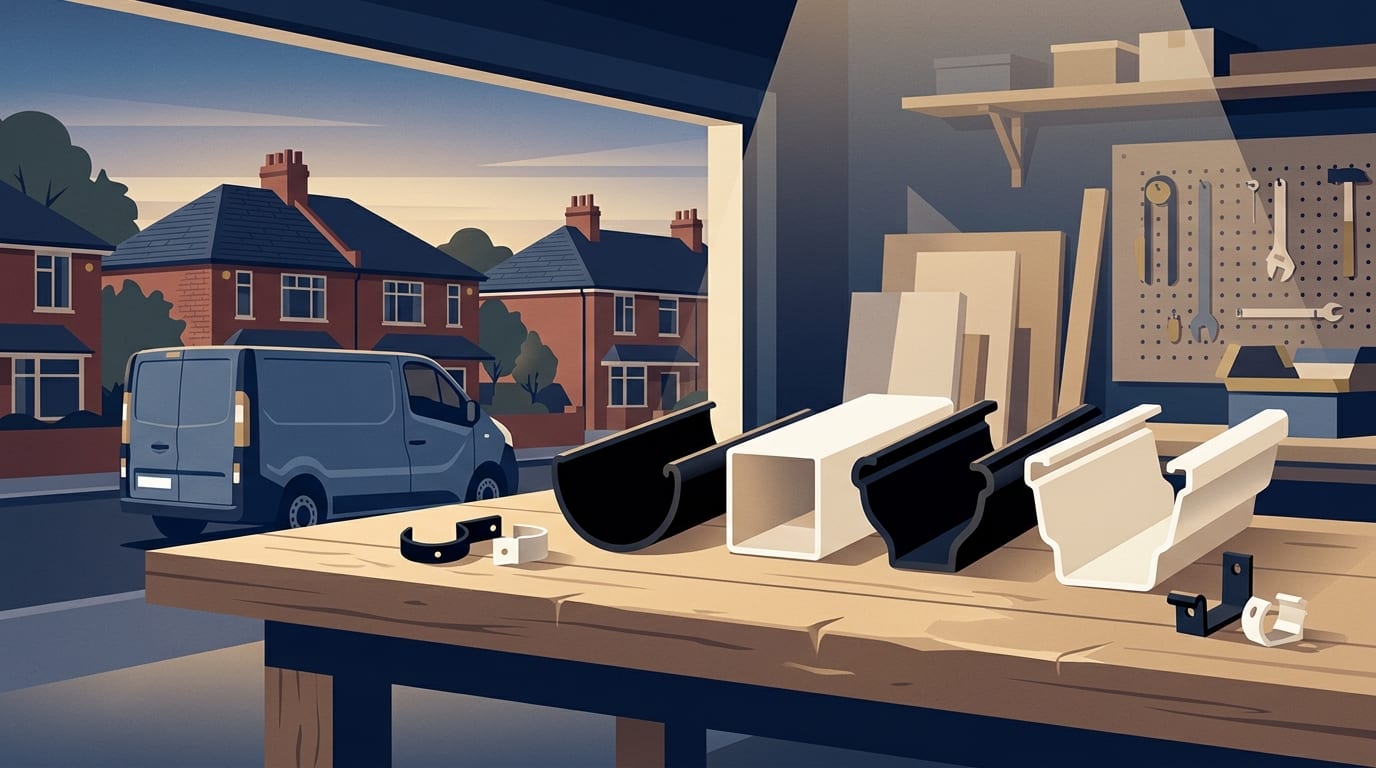
Half Round, Square, Ogee and Deep Flow Gutter Profiles Compared
How half round, square, ogee and deep flow gutters differ in looks and capacity, what each costs per metre in 2026 and how to choose one when you replace.

Eaves Trays Explained and What Fitting Them Costs
What eaves trays are, how rotten felt at the roof edge lets rain run behind your gutters, what fitting trays costs in 2026 and how to check it is done right.

What Is a Soakaway and What to Do When It Stops Draining
What a soakaway is, how to tell if your downpipes drain to one, the signs it is failing, what clearing or replacing it costs and the rebate you may be owed.