
Are Gutter Guards Worth It for UK Homes?
TopRatedGutterCleaners.co.uk · 30 September 2026

Gutter guards are most likely to be worth it if your home sits under trees or has gutters that are awkward and costly to reach. They keep large leaves and moss out of the channel and can reduce how often you pay for professional clearing, but they do not make your gutters maintenance free. Having guards fitted to a typical three-bedroom semi costs roughly £250 to £450 in 2026, which you must weigh against the cost of regular professional cleaning.
What gutter guards are meant to do
When a gutter fills with debris, water cannot reach the downpipe and eventually pours over the edge. This can lead to damp patches on your walls or damage to the brickwork below. A gutter guard acts as a physical barrier across the top or inside the channel of the plastic guttering. Its job is to let rainwater pass through while catching the large materials that drop from trees or wash down from your roof tiles.
By stopping large clumps of moss and broad leaves from settling in the channel, guards keep the main water path open. They also stop debris washing into the downpipes, which are much harder to unblock than an open gutter. A guard does not stop dirt entering the gutter entirely, but it changes how the debris behaves. Instead of rotting down into a thick sludge that blocks the flow, leaves sit on top of the guard where they can dry out and blow away in the wind.
The main types of gutter guard
Installers offer several different systems to keep debris out of your guttering. The right choice depends on the type of debris falling on your roof and how your current gutters are fitted to the fascias.
Brush inserts sit directly inside the channel and look like large pipe cleaners. They are often called gutter brushes or hedgehogs by tradespeople. The bristles fill the channel and hold leaves and twigs near the top, while water runs through the bristles along the bottom of the gutter. They are fast to install because they simply push into place, but pine needles and small seeds can sometimes get trapped in the plastic bristles.
Mesh or grid covers sit across the top of the gutter to form a hard lid. Rainwater drops through the small holes in the grid, while leaves rest on the flat surface until the wind clears them. Some mesh systems clip onto the front edge of the plastic gutter, while others slip under the bottom row of roof tiles for extra support.
Foam inserts are porous blocks cut to the exact shape of your gutter channel. They fill the space entirely so that nothing solid can get inside. Rainwater soaks through the open pores in the foam and runs away underneath. They keep out most solid debris, but the pores can clog with dirt over time and the foam then needs taking out and cleaning.
How much gutter guards cost to fit
Prices for fitting guards are based on the type of property, the height of the roof and the length of guttering involved. A typical installation for a UK home costs roughly £200 to £500. Tradespeople quoting publicly in 2026 gave prices of £250 to £450 to supply and fit guards on a standard three-bedroom semi. Treat both ranges as a rough guide, as they come from a small number of published figures.
These prices assume straightforward access. If your gutters are difficult to reach because you have a conservatory or an extension below the gutter line, the installer may need to use a tower or an access platform. This requires more time and equipment, which pushes the price up. Three-storey houses also cost more because of the extra height and strict safety requirements.
When you ask for prices, make sure you get a quote rather than an estimate. A quote is a fixed price that the tradesperson must stick to, while an estimate is just a rough guess that can increase later. You should also check if the price includes a full clear out of the gutters before the guards go in. At least one of the 2026 quotes for a semi included a full clean in the fitting price.
Do gutter guards stop the need for cleaning?
Guards reduce the amount of heavy debris in your gutters, but they do not eliminate the need for maintenance. Fine silt, dust, small seeds and fragments of moss will still wash through the mesh or past the bristles. Over time, this fine dirt settles at the bottom of the channel and can provide a place for weeds to take root.
The guards themselves also need checking to make sure they are not blocked. Wet leaves can sometimes stick flat across a mesh grid, stopping rainwater from getting through and forcing it over the edge. Brush inserts can also fill up with trapped pine needles that do not blow away easily.
The usual advice for gutters without guards is a clean at least once a year, or twice a year in spring and autumn. Even with guards fitted, you still need to monitor the roofline. An official council building maintenance guide lists clearing leaves and debris from gutters and downpipes as a spring and an autumn task. It also advises checking for leaks during or just after rain, which is still worth doing whether you have guards installed or not.
Homes that benefit most
Guards offer the best value if your property sits directly under tall trees. If your roof is constantly showered with broad leaves in autumn or heavy moss in winter, a standard clean may not keep the gutters clear for long. Adding a physical barrier helps keep the system working between professional visits.
They are also useful for homes where the gutters are unusually difficult to reach. If a tradesperson has to hire a cherry picker or build a scaffold tower just to clear a blockage over a glass conservatory, the cost of a routine clean will be high. Fitting guards can extend the time between these expensive visits.
When gutter guards are not worth it
You should never pay to have guards fitted if your guttering is already damaged or failing. If you have seen a dripping joint, a damp patch on your brickwork, or a run of plastic that sags in the middle, covering it up will not solve the problem. The fault will continue to cause water damage to your home.
A sagging run usually means the support brackets have failed or were spaced too far apart. A dripping joint means the rubber seal inside has degraded and needs replacing. You must ask a professional to fix these faults before you think about adding inserts or mesh covers. If you are not sure what is causing the leak, read our guide on when a repair is enough to understand the common faults.
Replacing guttering is normally treated as maintenance. However, listed buildings and conservation areas may need consent for exterior changes, so you should check with your local council first before altering the roofline.
If you rent your home in England, report gutter faults to your landlord before arranging any repairs yourself. Under section 11 of the Landlord and Tenant Act 1985, the landlord of a short tenancy is legally responsible for keeping the structure and exterior in repair, and the law specifically names gutters and external pipes.
Comparing the cost with regular cleaning
To decide if guards make financial sense, you need to compare the fitting cost against what you currently pay for routine maintenance. A professional gutter clean is priced per job, based on the type and height of your property, how much debris has built up and how awkward the access is.
The table below shows typical professional gutter cleaning costs for homes outside London and the South East.
|
Property type |
Typical cost for a single clean |
|---|---|
|
Terraced house |
£60 to £90 |
|
Semi-detached house |
£80 to £120 |
|
Detached house |
£120 to £180 |
These figures are typical published prices for 2026, and local quotes will differ. If a standard three-bedroom semi costs £80 to £120 to clean, and fitting guards costs £250 to £450, the installation costs about the same as somewhere between two and six professional cleans. You can find more detail on regional variations in our guide on how much gutter cleaning costs.
There are two main methods for routine cleaning. A gutter vacuum is a wet and dry vacuum connected to lightweight poles with a curved nozzle, worked from the ground. It usually features a small camera on the pole so the inside of the gutter can be seen clearly. Manual clearing is done by hand from a ladder, tower or platform, and is still needed for some heavy blockages.
If you have guards fitted, a vacuum cannot easily pull debris through the mesh. The guards must be removed manually first, which takes extra time. Because guards do not stop fine silt entirely, you will still need to pay for occasional professional cleaning. The financial benefit comes from stretching the time between those visits.
Rules and protections when hiring an installer
If you decide to hire someone to fit guards, you have specific legal protections under the Consumer Rights Act 2015. The law requires any service to be carried out with reasonable care and skill. A proper job covers every run that was quoted, the outlets, and a check that the downpipes are flowing. If the installation is faulty, you have the right to ask for the work to be put right or to ask for your money back.
You must watch out for cold callers who knock on your door to say your gutters need urgent work and offer to quote on the spot. Selling a cheap gutter clean is a common tactic used to pressure homeowners into expensive and unnecessary roof repairs. If you agree to a service on the doorstep for more than £42, or if you book by phone or online, you normally get a 14-day cooling-off period. If you ask for the work to start during this time and then cancel, you only pay for what has already been done.
You should be wary of any tradesperson who demands you pay in full up front before the materials have arrived or the work has started. A reputable firm will usually invoice you once the job is finished and you have seen the results.
Gutter cleaning and guard fitting often involve working at height. The Health and Safety Executive (HSE) does not ban ladders, but it says they suit only low-risk, short-duration work. The Work at Height Regulations 2005 require all work at height to be properly planned, done by competent people and avoided where reasonably practicable.
The HSE guidance for people using ladders at work includes keeping three points of contact and setting the ladder at a 75-degree angle. It also says a ladder should not be rested against weak surfaces such as plastic gutters, and that no one should work within 6 metres horizontally of an overhead power line.
If a business transports the waste they pull from your gutters, they must be registered as a waste carrier. There is a public register where you can check their details. You must ask what happens to the debris, as a bad tradesperson might just dump the wet sludge in your garden. You should also check their insurance. Employers' liability insurance is compulsory for any business that has employees. Public liability insurance is not a legal requirement, but it is the cover that pays out if your property is damaged or someone is injured on site.
Questions to ask an installer
Before you agree to a quote for gutter guards, ask the tradesperson these questions to ensure you get a proper job:
- Does the fixed quote include a full clear out of the existing debris?
- Will you check that all the downpipes are flowing freely before fitting the guards?
- How easily do the guards come out when the gutters eventually need clearing of silt?
- Are you registered as a waste carrier and what happens to the debris?
- Can I see a current certificate for your public liability insurance?
- Will you take before and after photos so I can see the finished work?
Common questions
What is a hedgehog brush for guttering?
This is a generic term for a brush insert that sits inside the gutter channel. It has a wire core and stiff plastic bristles that fill the gutter and hold large leaves near the top, allowing rainwater to flow through underneath.
Do leaf guards for gutters cause blockages?
They can cause blockages if they are ignored completely. Wet leaves can mat across the top of mesh guards, and pine needles can get trapped in brush inserts. They need to be checked periodically to ensure water can still get through.
Are mesh guards for gutters better than brushes?
Neither is strictly better, but they suit different situations. Mesh guards form a flat lid that encourages wind to blow leaves away, while brushes are faster to install and fit easily around awkward corners.
Do gutter guards stop water pouring over?
They stop water pouring over if the cause was a blockage of large leaves or moss. If the water is pouring over because the gutter is sagging, the brackets are broken, or the downpipe is blocked below ground, adding guards will not solve the problem.
Next steps to take
Before you spend money on gutter guards, take a steady look at your property during the next heavy rain and follow these steps:
- Check whether water is dripping from a joint or running behind the gutter, which points to a repair job, or pouring over the front edge, which usually points to a blockage.
- Look at the trees around your home to see if broad leaves or pine needles are the main cause of your blocked gutters.
- Read our advice on what to check before you book to help you choose a reliable tradesperson.
- Ask three local firms for a fixed quote to supply and fit guards, and ensure they include a full clean first.
If you are ready to get quotes for a clear out or a guard installation, you can find a gutter cleaner near you using our directory to see local professionals ranked by their customer reviews.
Related Guides
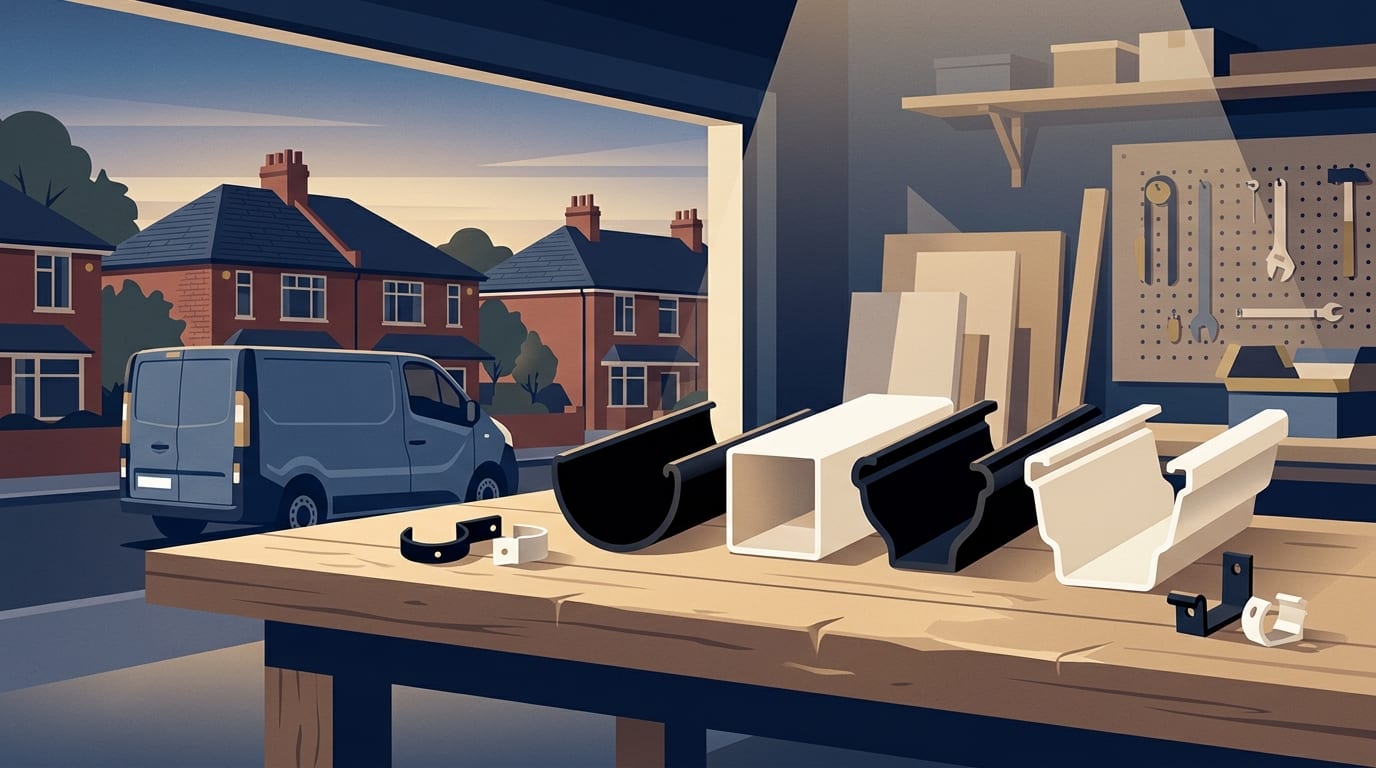
Half Round, Square, Ogee and Deep Flow Gutter Profiles Compared
How half round, square, ogee and deep flow gutters differ in looks and capacity, what each costs per metre in 2026 and how to choose one when you replace.

Eaves Trays Explained and What Fitting Them Costs
What eaves trays are, how rotten felt at the roof edge lets rain run behind your gutters, what fitting trays costs in 2026 and how to check it is done right.

What Is a Soakaway and What to Do When It Stops Draining
What a soakaway is, how to tell if your downpipes drain to one, the signs it is failing, what clearing or replacing it costs and the rebate you may be owed.