
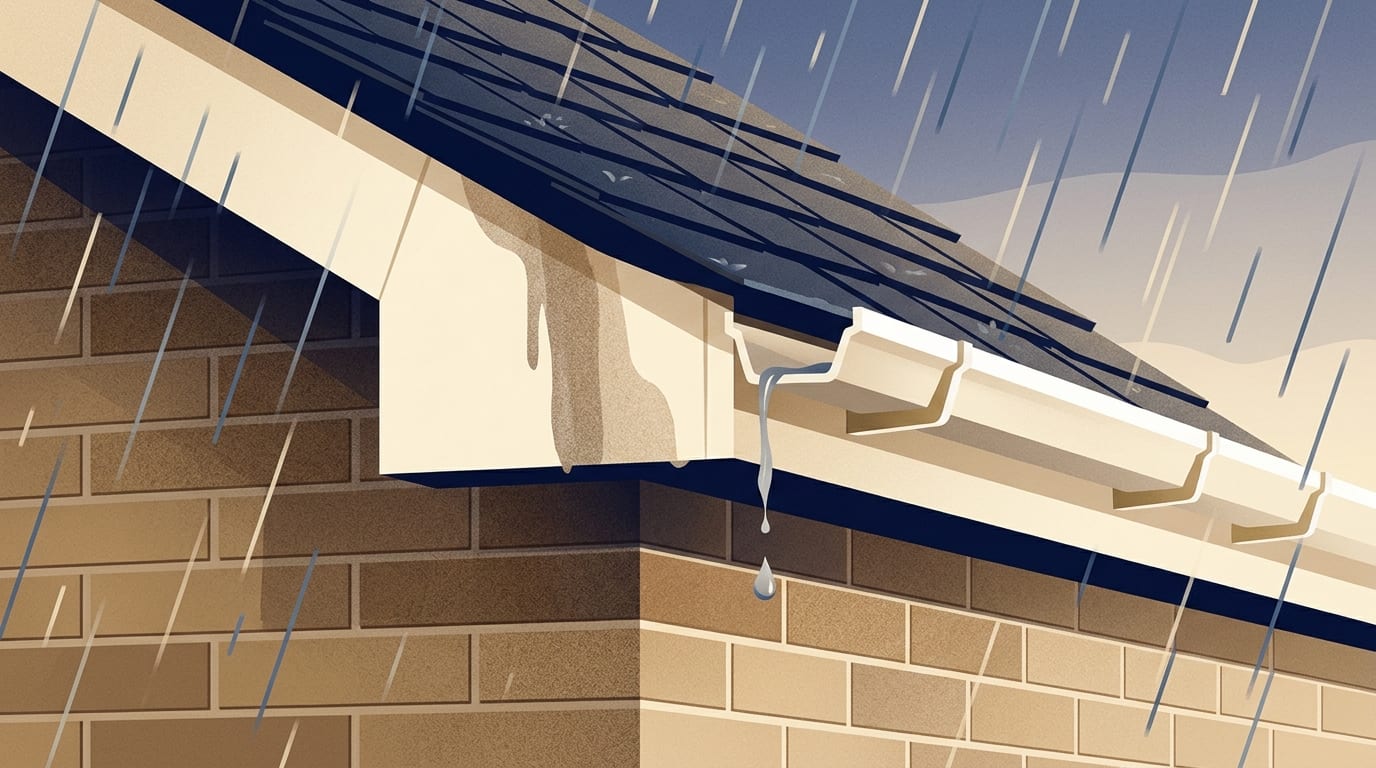
If your gutter looks clear but you can see water running down the fascia board or wall behind it, the rainwater is missing the channel completely. Water behind a gutter usually means the system is not catching the roof water properly because it sits too far from the roof edge, it sits too low, or a bracket has slipped. It can also happen if the run has sagged or an overloaded downpipe is splashing water over the back. This is a fitting fault rather than a routine cleaning job, and it needs to be looked at because escaping water can rot the fascia and affect the masonry.
Blockage or fitting fault
It is easy to assume any escaping water means the gutter is full of leaves or moss. You can normally tell the difference between a blockage and a fitting fault by watching the gutter from the ground during the next heavy rain. If the gutter is blocked, the water fills the channel and pours over the front lip, often along a wide stretch. A professional would fix this by clearing the debris.
When the problem is a fitting fault, the water never makes it into the channel in the first place. You will see it dripping or pouring between the back of the gutter and the fascia board. This might happen at just one point where a bracket has dropped, or it might happen behind the whole run if the gutter was installed too far out.
Pay attention to exactly where the water leaves the system. If it is overflowing at the front, you likely need a standard gutter clean. Gutter cleaning is usually priced per job, based on the type and height of the property, the length of guttering, how much debris has built up and how awkward the access is. A gutter vacuum is a wet and dry vacuum connected to lightweight poles with a curved nozzle, worked from the ground, usually with a small camera on the pole so the inside of the gutter can be seen. Manual clearing is done by hand from a ladder, tower or platform, and is still needed for heavy blockages.
If the water is running down the back, paying for a clean will not solve the problem. A professional will need to adjust or re-fix the brackets to correct how the gutter catches the rain. Keep in mind that replacing guttering is normally treated as maintenance, but listed buildings and conservation areas may need consent, so check with the council if you live in a protected property.
Why water gets behind the gutter
Rainwater misses the guttering when the channel is no longer aligned with the edge of the roof tiles. This can happen when original timber gutters are replaced with plastic guttering. The new guttering is set further away from the wall face, so it is no longer below the ends of the old roof tiles. The water simply drops straight down behind it. A problem like this may not be fully understood from the ground, which is one reason a tradesperson needs to look at it.
Gutters also pull away from the wall when they sag. A gutter starts to sag when the weight inside is too much for the brackets. This excessive weight can be caused by heavy blockages, a build up of snow, or improper installation. Once a section drops or bends outwards, the water coming off the roof misses the back edge and runs down the wall.
Sometimes the issue is caused by physical impact rather than weight. Damage can make water escape because systems can be cracked, dented, snapped and bent out of shape. The Health and Safety Executive guidance for people using ladders at work says a ladder should never be rested against weak surfaces such as plastic gutters.
Position of the gutter against the roof edge
A gutter only works when it is positioned at the correct height and angle to catch the water leaving the roof. The outlet position should be no more than 50mm below the level of the roof. A gutter that sits lower than this may not catch the roof's water properly.
The gutter also needs a slight tilt so the water flows towards the downpipe instead of sitting in the channel. The recommended fall is a gradient of 1:350, which is roughly a 3mm drop for every 1 metre of guttering. If this fall is wrong, water can pool in the channel and add weight.
A proper repair job covers everything that was quoted. Common extras you might ask for during this kind of work include:
- Unblocking downpipes and checking they are flowing.
- Cleaning fascias and soffits.
- Resealing a leaking joint.
- Replacing brackets.
- Fitting gutter guards.
Fascia boards and loose brackets
The brackets hold the gutter in the correct position, and they rely on the fascia board being strong enough to take the screws. A proper survey should check whether plastic fascia boards are full replacement boards or thin covers fitted over timber. Covering damp or rotten wood traps the problem and provides a weak fixing for gutter brackets.
If the screws pull out of a rotten timber board beneath a thin plastic cover, the bracket drops and the gutter sags away from the roof edge. Water then runs behind the run. Even if the fascia is solid, a gutter can sag if there are not enough brackets to support the weight of the water.
Brackets should be no more than 1000mm apart. Furthermore, no more than 150mm (5.9inch) should be left between a bracket and any join, bend or stopend. If you can see gaps of more than a metre between the clips on your house, the gutter may sag, which can leave a gap where water escapes.
If you rent your home, you might wonder who should pay for the repair. In England, section 11 of the Landlord and Tenant Act 1985 makes the landlord of a short tenancy responsible for keeping the structure and exterior in repair, and it names gutters and external pipes. If the brackets are loose and the gutter is leaking behind, you should report it to your landlord.
What the water does to the wall and fascia
Water running behind a gutter is a serious defect because it directs rain straight into the fabric of the building. The Society for the Protection of Ancient Buildings notes that concentrated and prolonged wetting is likely to cause damp patches and plaster mould on walls and ceilings, and the decay of timber. Rainwater running down the fascia board can rot the wood.
When the water continues down the face of the brickwork, it affects the mortar and anything fitted to the wall below. The same guidance states that external joinery can be attacked by wet rot where there are leaks above doors and windows. This means a leaking gutter can lead to wet rot in joinery near the leak.
Masonry can also suffer from algae growth and eroded mortar joints.
What a repair involves
Fixing water running behind a gutter is a job for a professional because it requires working safely at height. The Health and Safety Executive warns that working at height remains one of the biggest causes of fatalities and major injuries, and common cases include falls from ladders and through fragile surfaces.
The Work at Height Regulations 2005 require work at height to be properly planned, done by competent people and avoided where reasonably practicable. Ladders are not banned, but they suit only low risk, short duration work, and work on gutters above ground level should be left to a trade with proper access equipment.
The repair usually involves re-aligning or re-fixing the run so it sits in the correct position against the roof edge. The worker may re-fix the brackets, check the condition of the fascia board and space the clips no more than 1000mm apart. If the old clips are snapped or bent out of shape, they may be replaced with new brackets.
If the gutter is already positioned correctly but water is still tracking back under the roof tiles, the roof edge might need a trim or a tray to bridge the gap. You can learn more about what fitting eaves trays costs in our dedicated guide. Do not try to adjust gutters or brackets yourself, because this is work at height.
What it costs in 2026
The price of fixing a gutter that lets water run behind it depends on what needs to be adjusted and how easy the gutter is to reach. Conservatories and extensions below the gutter line and three-storey houses cost more. Awkward jobs may need a tower or access platform, which adds cost.
Replacing a bracket or clip and re-securing or re-aligning a sagging gutter run are classed as routine repair jobs. If the damage is minimal and only one section needs lifting back into place, the cost will be at the lower end of the scale.
The table below shows typical 2026 prices for these repairs. If the tradesperson needs to hire a scaffold tower or erect scaffolding to reach a difficult area safely, this adds to the final bill.
|
Repair job or access equipment |
Typical price |
|---|---|
|
Starting price for securing a sagging gutter with minimal damage |
£60 |
|
Average gutter repair in the UK |
£215 |
|
A 5-metre repair including labour |
£180 to £250 |
|
New uPVC brackets (each, supplied and fitted) |
£10 to £15 |
|
Extra cost if the gutter needs cleaning first |
Around £100 |
|
Scaffold tower hire (per week) |
£40 to £115 |
|
Erected scaffolding for a single elevation on a two-storey house |
£300 to £800 |
These are typical 2026 prices. Local quotes will differ based on where you live and the specific layout of your property. The professional may ask for the gutter to be cleaned first so the fault can be seen clearly.
What to put in the quote
When you ask a local company to look at water escaping behind your gutter, make sure you get a fixed quote rather than an estimate. A quote is a fixed price, while an estimate is not and can increase once the work starts. Under the Consumer Rights Act 2015, the service must be carried out with reasonable care and skill, and if it is not you can ask for it to be put right or for money back.
To avoid disagreements later, ask the tradesperson to list exactly what is included in the price. A thorough quote for re-aligning a gutter should list the following details clearly:
- What fault was found during the initial inspection.
- How the gutter will be re-fixed or re-aligned.
- The condition of the fascia board and whether it can hold the screws.
- The access method to be used, such as ladders, a tower or scaffolding.
- Any call-out charge if they are visiting just to inspect the problem.
- Before and after photos of the adjusted brackets and alignment.
Be wary of cold callers who knock on your door, say the gutters or roof need urgent work, and quote on the spot. A common tactic is offering a cheap gutter clean which is then used to sell roof repairs you do not need. A service agreed on the doorstep, by phone or online normally carries a 14-day cooling-off period.
You should also ask for a current certificate of insurance. Employers' liability insurance is compulsory for a business with employees. Public liability insurance is not a legal requirement, but it is the cover that pays if property is damaged or someone is injured. A business that transports waste as part of its work must be registered as a waste carrier, and there is a public register. Always ask what happens to the debris if the gutter is being cleaned as well as repaired.
Common questions
Why is water dripping behind my gutter but the gutter is clean?
If your gutter is completely clear of debris, water dripping behind it usually means the channel is not catching the roof's water properly. The gutter may have been installed too far from the wall face, or it might be sitting more than 50mm below the roof edge. It is a fitting fault, and a tradesperson needs to look at it to decide the right fix.
Can a blocked downpipe cause water to run behind the gutter?
A blocked downpipe normally causes water to pool in the channel and overflow over the front lip. However, the trapped water adds weight to the plastic run. This weight can cause the gutter to sag away from the fascia board, creating a gap at the back where water escapes.
Does my home insurance cover water damage from a sagging gutter?
Check your own policy wording and do not assume you are covered. If the escaped water has caused damp inside, you can read the guide on whether insurance covers blocked gutter damage.
Can I just seal the gap between the gutter and the fascia?
Do not try to seal the gap between a gutter and a fascia board yourself. It is work at height, and the fault behind it needs a tradesperson to look at the alignment, brackets and fascia.
Do I need a roofer or a gutter cleaner to fix this?
Some gutter cleaners can handle basic repairs like replacing snapped brackets or re-securing a sagging run. If the problem is caused by a missing roof edge trim or broken tiles pushing the gutter out of place, you may need a roofer. Read the guide on who fixes gutters to help you choose the right trade for your specific fault.
Next steps for fixing the leak
Water running down the wall behind your gutter is a clear sign that the system needs adjusting. Before you hire someone to fix it, follow these steps to make sure you get the right repair:
- Watch the gutter during heavy rain to confirm the water is running down the back, not overflowing at the front.
- Check from the ground if there are large gaps between the brackets, keeping in mind they should be no more than 1000mm apart.
- Look closely at the fascia board for peeling paint or obvious signs of rot that might stop a screw from holding.
- Ask the tradesperson to confirm whether you have solid timber fascias or thin plastic covers fitted over wood.
- Request a fixed quote that details exactly how the gutter will be re-aligned and what access equipment will be used.
Escaping rainwater can cause serious damp problems and rot if it is left to soak into your walls and window frames. When you are ready to get the problem looked at, you can find a gutter cleaner near you to inspect the brackets and quote for the repair.
Find a top rated gutter cleaner near you
604 gutter cleaners across the UK, each ranked on their Google rating and the number of reviews behind it. Start with your county:


